Free on-site estimatesServing Austin, Dallas, Houston, Fort Worth & San AntonioContact our fence specialists

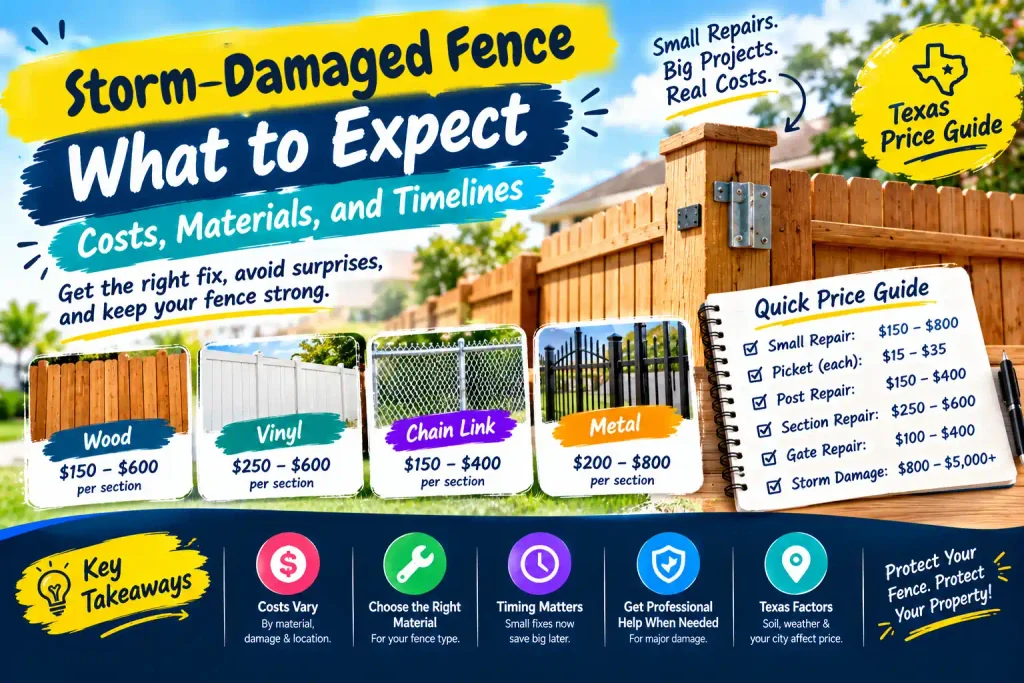
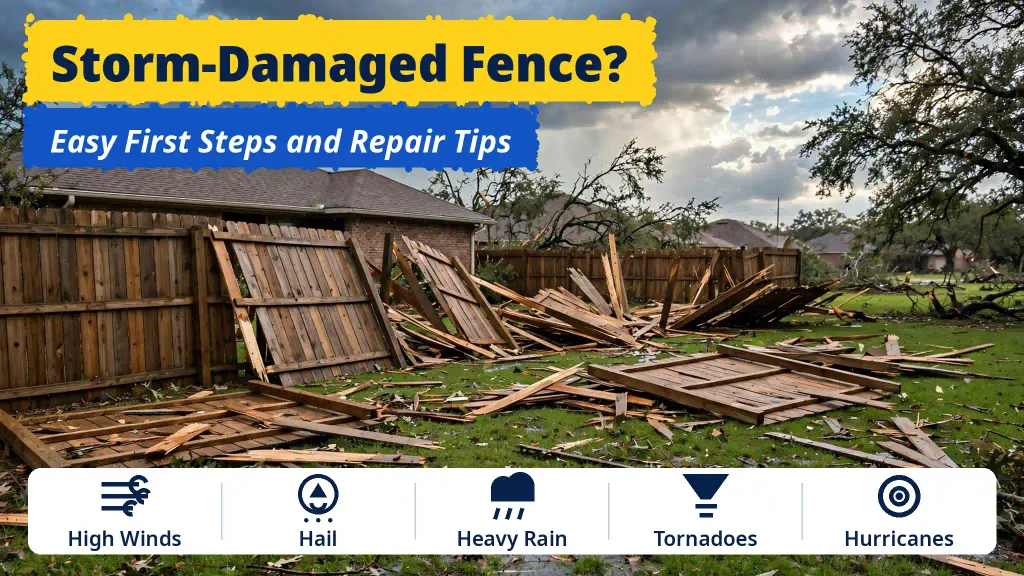
Before you clean up or fix anything, a storm-damaged fence needs a safety check. Take photos of the damage, read through your homeowners insurance policy, and block off any broken sections so children, pets, and nearby property aren’t put at risk. Texas storms bring wind, hail, and heavy rain, and the shifting soil underneath can make things worse for boards, posts, rails, and gates alike. Small repairs are often manageable on your own, but if posts are loose or the damage runs along a long stretch of fence, you’ll usually want a professional.
First 24 Hours With a Storm-Damaged Fence
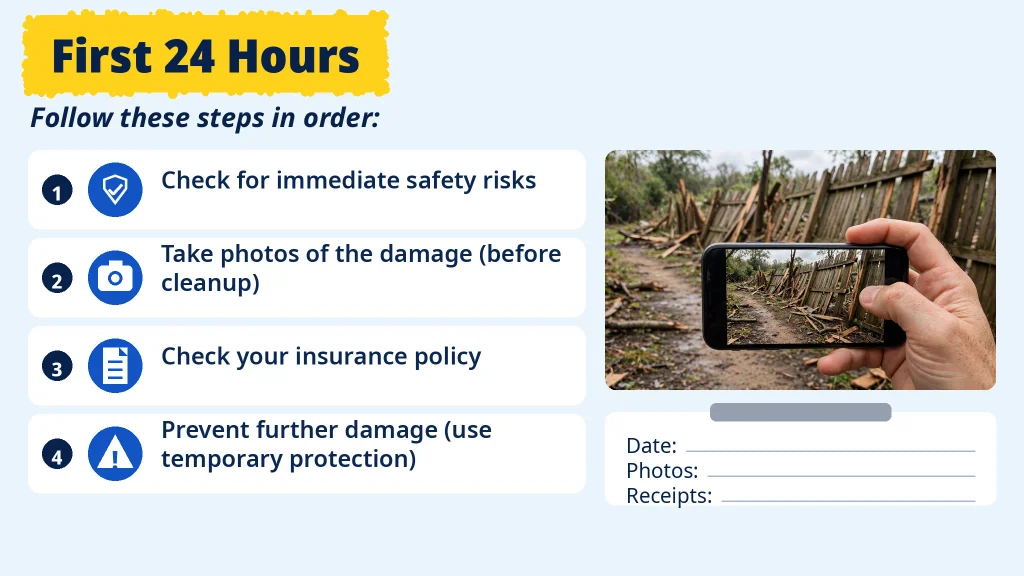
The first day with a storm-damaged fence comes down to four tasks, and the order they go in really does matter. You need to stay safe, record the damage, look into your insurance, and stop things from getting worse. Skipping ahead can mean an injury or lost money, and neither is worth the risk.
Step 1: Check for Immediate Safety Risks
Stay back until you’ve confirmed the area is safe. Fallen sections, wobbly posts, and sharp pieces of metal can hurt you more easily than you’d think. If a power line is down near the fence, treat it as live and keep your distance while you call the utility company, and call 911 as well if someone is injured. Ready.gov has more on power outage safety.
Step 2: Photograph the Damage Before Cleanup
Before you pick up a single board, take photos of the storm-damaged fence. Wide shots come first so the whole fence line is visible, and then you can move closer to the broken posts, panels, rails, and gates. Don’t forget any fallen sections or damage nearby. Jot down the date, and hold on to every receipt from the cleanup.
Step 3: Check Your Insurance Policy
Get your policy out before calling anyone, and find your coverage, your deductible, and the filing deadline. Some Texas wind and hail policies only give you a year, although yours could be different. Keep the broken pieces until your insurer says it’s fine to throw them out, because they might want to look at them. If something is unclear, the Texas Department of Insurance can answer your questions.
Step 4: Prevent Further Damage
Keep people away from any part of the fence that looks unsteady. When it’s safe, move things like the grill, planters, and bikes out of the way, and then close off the gap with rope or caution tape so kids and pets can’t get through. Heavy lifting and risky fixes can wait. It’s also worth checking the forecast, because another round of wind or rain might be all it takes to bring down a fence that’s already weak.
How to Assess a Storm-Damaged Fence
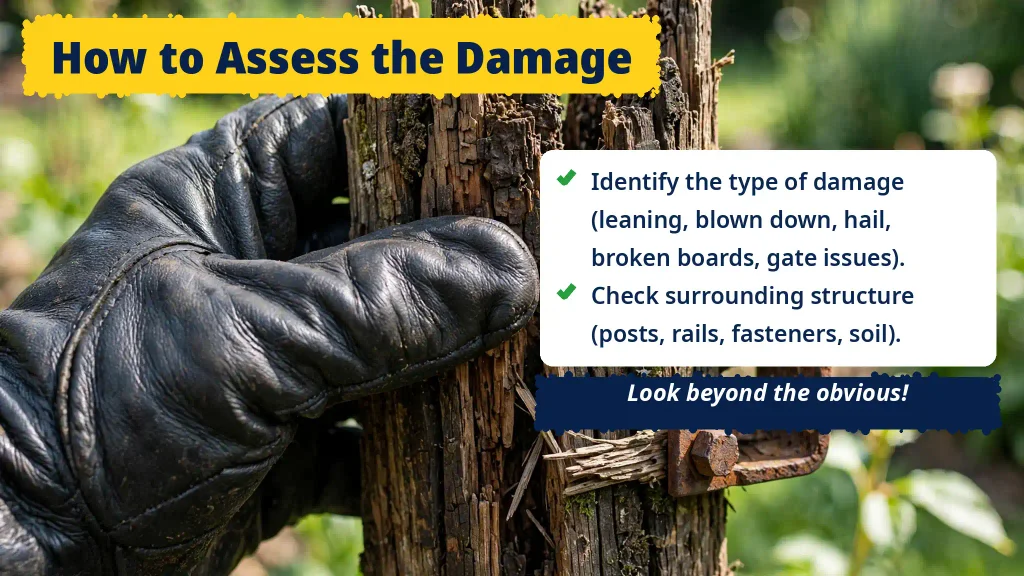
After the area is safe, walk the fence line at a slow pace. Start by working out what type of damage you have, and then look closely at the parts around it.
Identify the Type of Damage
Storm damage usually fits into one of five categories: a lean, a blow-down, hail damage, broken boards or rails, or a faulty gate. A leaning fence often means the posts have shifted or the footings are weak, whereas one that blew down tends to have snapped posts or connections that let go. Hail leaves chips, dents, and splits behind. Boards and rails usually break because something struck them or because the fasteners were already loose, and bent hinges, poor alignment, or broken supports are the telltale signs of a gate problem.
Check the Surrounding Structure
The break you can see isn’t always the whole story. Damage tends to hide behind fallen sections, so check the nearby posts, rails, fasteners, and gate connections for rot, cracks, or loose footings. Give the posts that look fine a push, too. A post that moves a lot isn’t as strong as it appears.
Soil is part of the picture as well. The clay in much of Texas swells when it gets wet and shrinks as it dries, and over time that cycle can loosen footings. When you’ve finished looking things over, ask yourself whether you’re dealing with one bad spot or a long stretch of fence.
Temporary Ways to Secure a Broken Fence
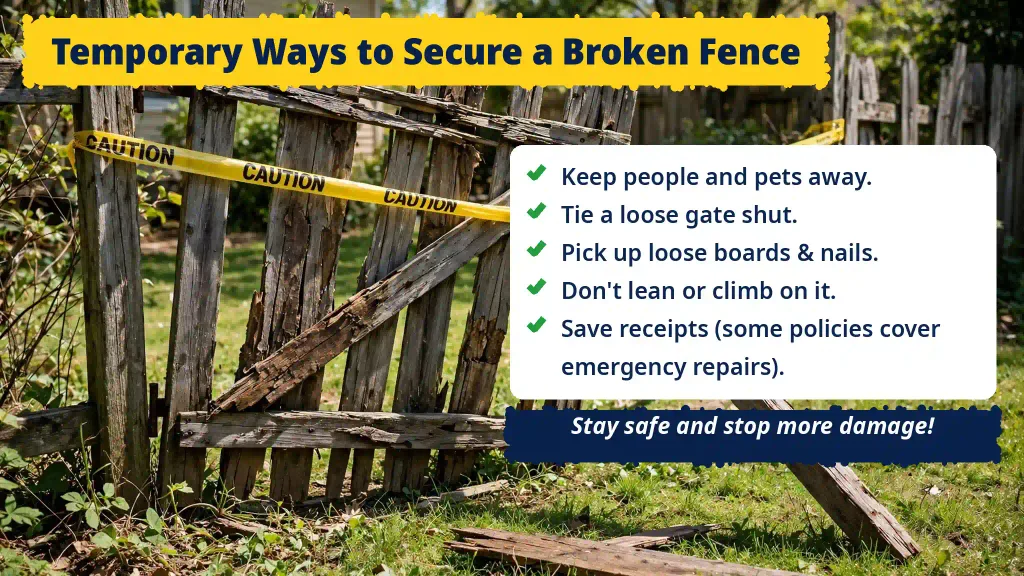
Temporary fixes are meant to stop a storm-damaged fence from getting worse, not to replace real repairs. If a post is leaning and its footing looks shaky, don’t push it upright, because it can swing the opposite way. Heavy or sharp panels that have fallen should stay where they are until you can lift them safely. Small loose boards and nails are fine to pick up so the wind doesn’t throw them around, as long as you’re wearing gloves.
A gate that won’t latch can be tied shut with a rope or chain to keep it from swinging in the wind. Try not to lean on the fence or climb it either, since it could be weaker than it looks. Some policies pay for reasonable emergency repairs, so keep what you spend low, read through your policy, and save every receipt.
Repairing a Storm-Damaged Fence by Damage Type
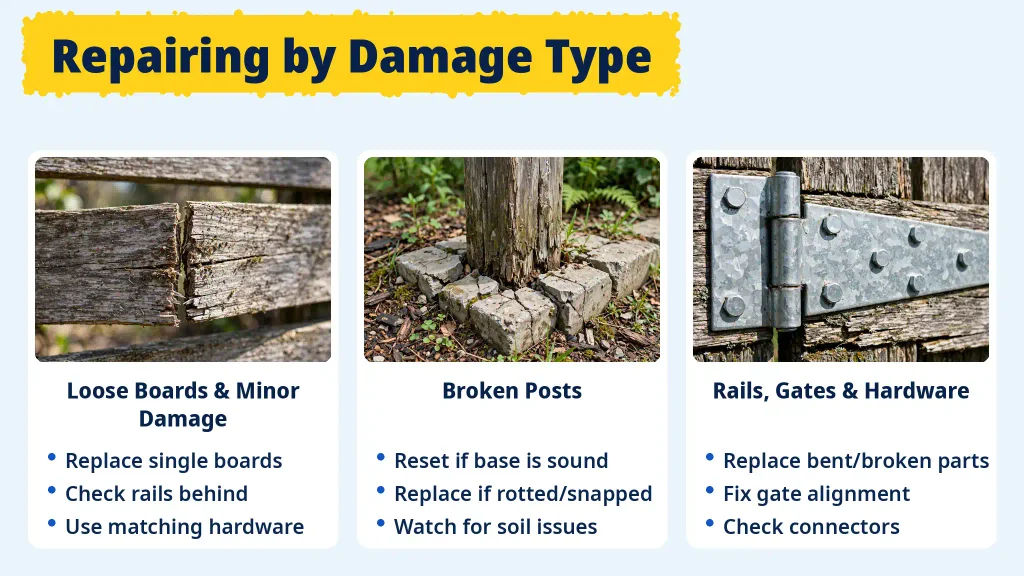
What you do next should depend on what actually broke. The sections below go through boards, posts, and hardware, and they also point out where DIY stops being a good idea.
Loose Boards and Minor Panel Damage
Cracked boards or pickets can usually be swapped out one at a time. Try to buy boards and hardware that match so the repair blends in and lasts. It’s worth checking the rails behind the boards before you nail anything, because even new boards won’t hold up on a weak rail.
Broken Fence Posts: Reset or Replace
A post can be reset only when its base is still solid, and if it has snapped or rotted, it needs replacing. Look at the post and the soil around it first, since rot, a broken base, a shifted footing, or washed-out soil can change what you need to do. And if several posts are unstable, you’re no longer looking at a one-post fix.
Damaged Rails, Gates, and Connections
Bent or broken parts shouldn’t be straightened, so replace them instead. Go through each hinge, latch, bracket, rail, and fastener to see what needs to be swapped out. After the structure is solid again, check that the gate swings and latches without a fight, because a gate that’s slightly off today usually gets worse over time.
Know When DIY Is Not Safe
DIY isn’t a good idea if the panels are too heavy for two people or the posts won’t stay in place. The same goes for several collapsed sections or damage along a long stretch of fence, which really calls for a professional. A rough test is to ask yourself whether the job seems like too much for you and a helper. If it does, trust that feeling.
When to Call a Texas Fence Professional
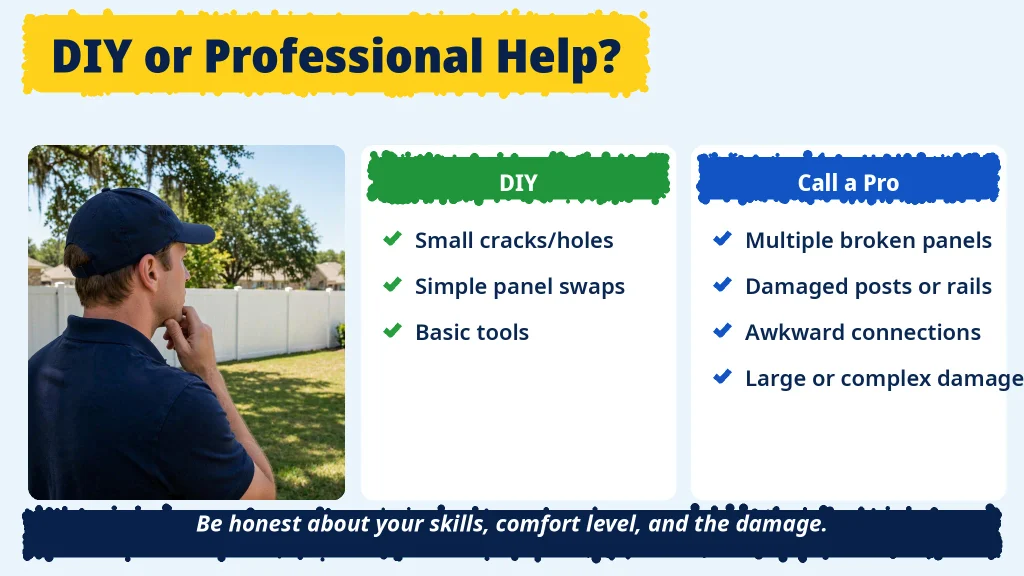
A professional should handle emergency fence repair when a storm-damaged fence puts people or property at risk. That might be a gate that won’t close, a gap you have no way to block off, or heavy pieces and loose footings sitting close to a driveway, sidewalk, or your neighbor’s yard. If your temporary fix didn’t hold up, or you honestly can’t tell what caused the damage, go ahead and call.
Response times differ from company to company, so try not to wait too long. When a quote comes in, save it with any notes you took, since your insurer may ask to see them. If you’d like a professional to look at your fence, call or see our fence repair services
Repair or Replace After a Storm?
If the damage is limited and most of the posts, rails, and panels are still in good shape, repairing the storm-damaged fence is the better call. A partial repair works when only a few sections are damaged and the rest is holding up. Full replacement makes more sense when the damage is widespread, the material is badly worn, or the repairs simply don’t add up.
Think about materials, labor, removal, and how the surviving sections will look beside the new ones before you decide. You’ll also want to consider how much life the old parts have left, since a cheap patch on an older fence might only buy a little time. If you’re still unsure, get a professional opinion before committing.
What Affects Fence Repair Costs After a Storm?
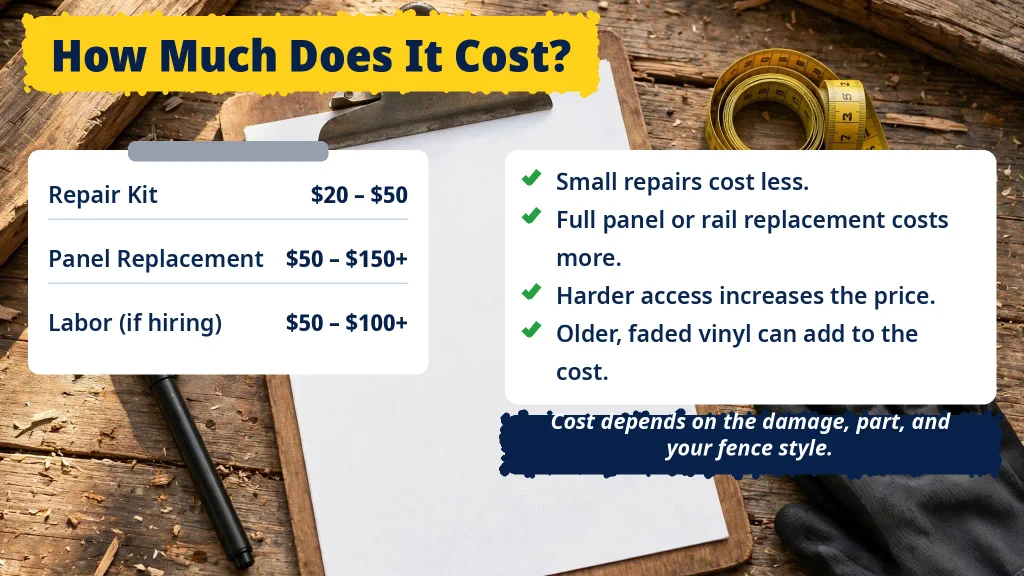
Material, the size of the damage, and labor are the biggest factors in what storm-damaged fence repair costs. Wood, vinyl, chain link, and metal all come with different prices and different repair methods. The more panels, posts, rails, and gates that are damaged, the bigger the bill will be, particularly if the footings need work.
Site access, debris removal, and finding matching parts can add more to the total. Sometimes a closer inspection reveals hidden damage, which means the first estimate can change. Prices also differ across Texas, so comparing a few companies is a smart move.
FAQs
Should I repair my fence right after a storm?
Not right away. Safety and temporary protection should come first, and permanent repairs can wait until the damage can be looked at safely. An unstable fence might come down while you’re working on it, so give yourself a little time to look it over.
Will homeowners insurance cover a storm-damaged fence?
That depends on your policy. The cause of the damage, any exclusions, and your deductible all affect the outcome, and rot or normal wear usually isn’t covered. Read your policy and then ask your insurer what proof they need for a claim and how long you have to file.
Can I fix a fence that has blown down?
Sometimes. A few broken boards or one loose post can usually be fixed, but several broken posts or an unstable base should be looked at more closely first. If the fence is leaning, cracked at the base, or too heavy to lift, it’s best to have a professional take a look.
How do I stop more damage before repairs?
Go back and check the weak spots on your storm-damaged fence after each new bout of wind or rain, because posts that were loose before may be even looser now. Take photos of any temporary measures you add so your insurer can see what you did, and keep the area closed off until the repair is done.
In a Nutshell
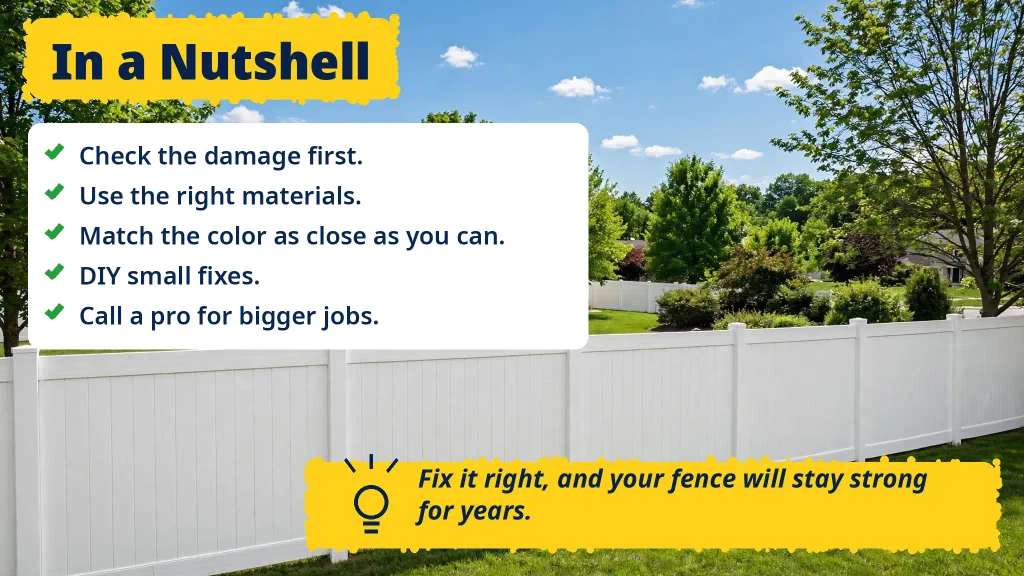
Begin with safety, take your photos, protect the area, and then work out what kind of repair you’re dealing with. DIY is only a good option for minor damage that’s safe to handle. When posts are unstable or the damage covers a wide area, let a professional take over. The fence can wait a day, but your safety can’t.