Free on-site estimatesServing Austin, Dallas, Houston, Fort Worth & San AntonioContact our fence specialists

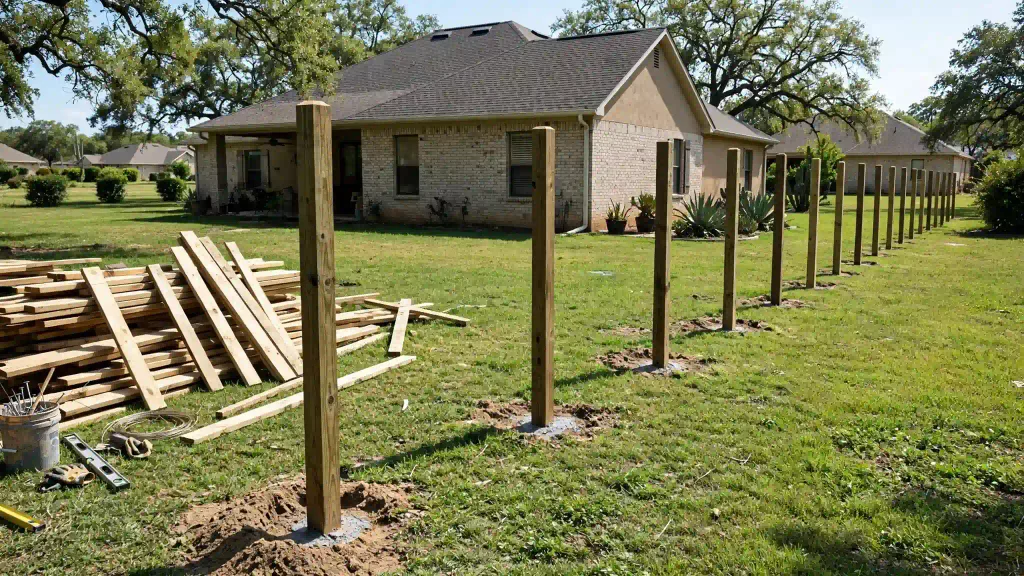
Getting your fence post count wrong can cost you more than a few extra trips to the hardware store. Order too few, and your installation comes to a stop halfway through. Order too many, and you’re left paying for materials you may never use. Fortunately, you can calculate fence posts with one simple formula: number of sections + 1.
This guide shows you how to calculate fence posts for a Texas fence installation, including corners, gates and different fence layouts. You’ll also learn how to estimate rails, pickets and concrete from the same measurements, so you can plan your material order without unnecessary guesswork.
The Formula to Calculate Fence Posts
For a fence with two open ends, posts equal sections plus one. A section is simply the space between two posts. Divide the run length by your post spacing, round up to a whole number of sections, then add one post for the end of the run. Calculate fence posts for each straight run between corners or gates
Here’s an example. Say you have a 100-foot fence with posts 8 feet apart. 100 divided by 8 is 12.5, which rounds up to 13 sections, so you need 14 posts. If you stop at 13, you’ll come up one post short. For a site-built fence, since you rounded up, spread the 14 posts evenly at about 7 feet 8 inches instead of 8 feet so the last section doesn’t end up as a short stub. For pre-made panels, keep full-width spacing and trim only the final panel.
There is one exception. A fence that closes back on itself, like a fully enclosed yard, has no open ends. In that case, once you round up the sections for each straight run between corners, total posts equal total sections.
What Changes Your Post Spacing
Post spacing depends on three things: the fence material, its height and exposure to wind, and the ground it sits on. The table at the end of this section lists the usual ranges.
Fence Material
Wood and vinyl privacy panels are solid and catch the wind, so their posts go closer together. Chain link is light and open, which lets you space the posts farther apart. Iron spacing follows the panel width, so check that number first.
Fence Height, Length and Wind
A taller fence catches more wind and needs closer posts. For a 6-foot privacy fence, 8-foot spacing is standard. In areas where storms hit hard, 6-foot spacing is worth considering. A longer run needs more posts overall, but the spacing itself stays the same.
Soil, Slope and Terrain
Soft or wet ground grips a post less firmly, so set posts deeper in those spots. Slopes affect your count too, because you need a post wherever the grade changes. Walk your yard before you place an order.
| Fence Material | Spacing | Notes |
| Wood privacy | 6 to 8 feet | 8 feet is standard |
| Vinyl | 6 to 8 feet | Follow the manufacturer |
| Chain link | 8 to 10 feet | Light and open |
| Iron and ornamental | 6 to 8 feet | Match the panel width |
Step 1: Measure Your Fence Line
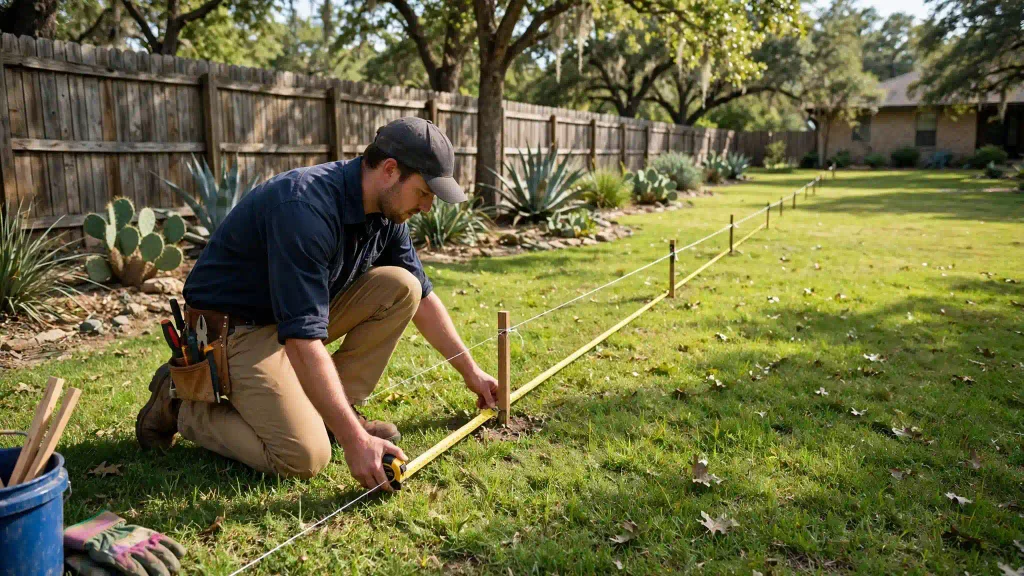
Measure the line where the fence will actually stand, not the one on a map. Walk each run with a long tape or a measuring wheel. Mark every end, corner, gate opening and change in level, then write down each length.
Keep those lengths separate, because you’ll calculate fence posts one run at a time. A run is the stretch of fence between two fixed points, such as a corner, a gate or an end. Measure along the ground, since that’s the path the fence will follow.
Step 2: Calculate Fence Posts for Each Run
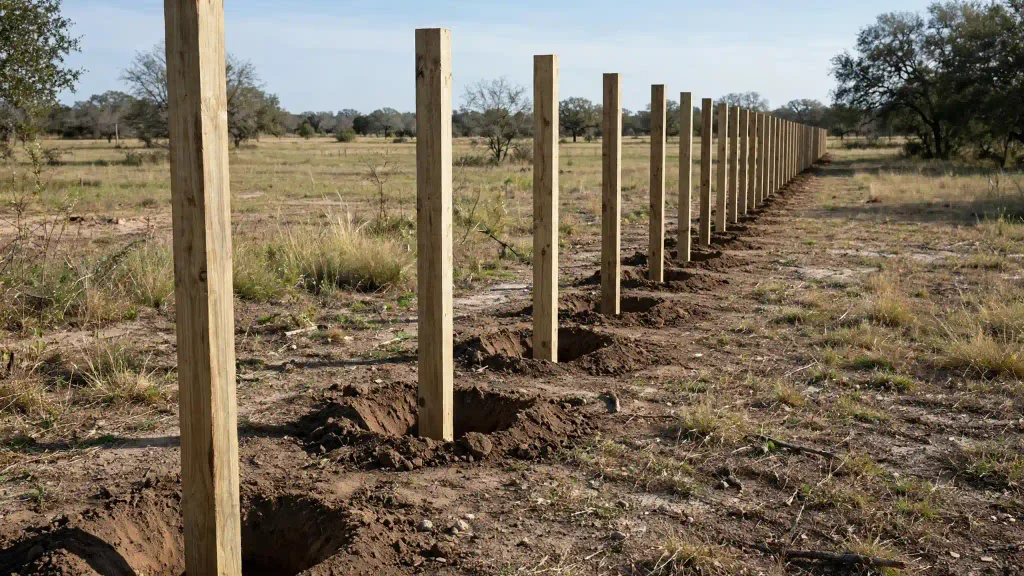
Take one run at a time, since each has its own length, spacing and post count. Pick your spacing from the table above. Divide the length by the spacing, round up to whole sections, and add one post.
The table below shows common run lengths and how many posts each one needs. Keep in mind that the spacing is a maximum. After rounding up, your posts will sit slightly closer together than the number shown.
| Length | Max spacing | Sections | Posts |
| 50 feet | 8 feet | 7 | 8 |
| 100 feet | 8 feet | 13 | 14 |
| 100 feet | 6 feet | 17 | 18 |
| 150 feet | 8 feet | 19 | 20 |
| 200 feet | 10 feet | 20 | 21 |
Step 3: Handle Gates, Corners and Ends
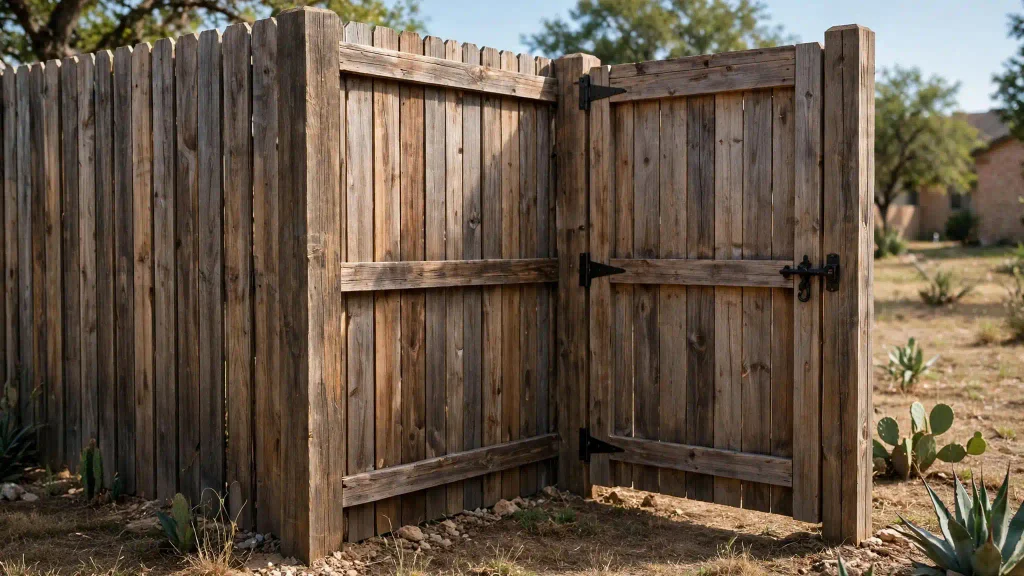
When you calculate fence posts, corners, gates and ends are already part of your count, so you don’t add them on top. What matters is how you measure around them.
Line, Corner, End and Gate Posts
A line post stands in a straight run. A corner post sits where the fence turns and takes pull from two directions, so set it deeper. An end post marks where the fence stops. A gate needs two posts, one for the hinge and one for the latch, and both should be larger or deeper than a line post.
A Worked L-Shaped Run
Picture a yard with a 60-foot run and a 40-foot run that meet at a corner. At 8-foot spacing, the first run has 8 sections and 9 posts, and the second has 5 sections and 6 posts. The corner post belongs to both runs, so subtract one. The total comes to 14 posts.
A Worked Gate Example
Now put a 4-foot gate in the middle of a 100-foot straight run. Treat the opening as a break. Subtract it, then split the remaining 96 feet into two 48-foot runs. Each run has 6 sections and 7 posts, so the total is 14. The gate posts are the last post of the first run and the first post of the second, so they’re already counted. You just need to make those two heavier or deeper than the rest.
Two cautions apply here. If a gate sits at the very end of a fence with nothing beyond it, add one post for the far side of the opening. Also, splitting a run can shift the total by one, because each piece rounds up on its own.
Step 4: Choose Post Length and Depth
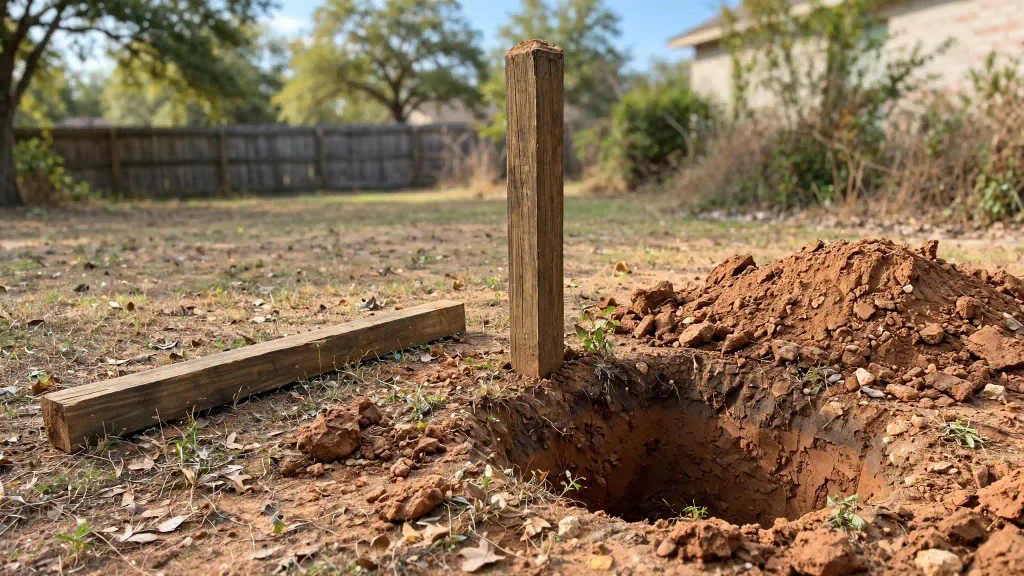
Once you calculate fence posts, a common rule of thumb is to bury about one third of each post. It’s a guideline, not a code requirement, so check your local rules. For a 6-foot privacy fence, a 9-foot post leaves 3 feet underground. Shorter posts can work with less depth, but burying a full third gives you more margin against wind.
Texas clay swells when it’s wet and shrinks when it’s dry. That constant movement can work a shallow post loose, so lean toward the deeper end of the range. Corner and gate posts carry more load, so set them deeper still. Before you finalize your plan, ask your supplier which post lengths they stock.
Step 5: Rails, Pickets and Gate Hardware
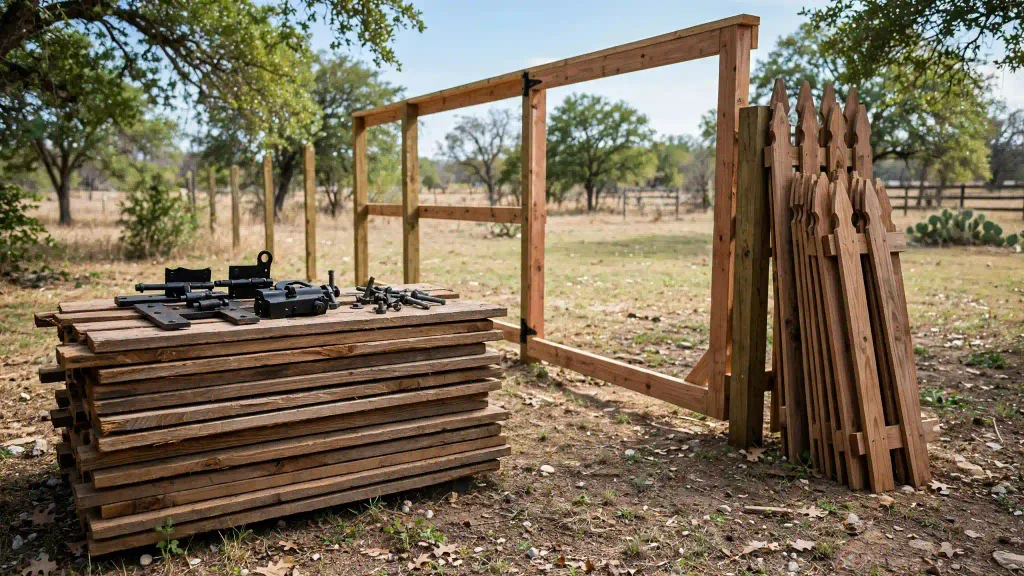
You don’t calculate fence posts to get rails and pickets, because those come from your sections and fence length. A 6-foot wood privacy fence usually has 3 rails per section, though some builders use 2, so check your plan. At 3 rails, 13 sections need 39 rails.
For pickets, divide the fence length in inches by the picket width plus the gap. A 100-foot fence is 1,200 inches, and a standard 1×6 picket is about 5.5 inches wide. Set tight together, you’ll need 219 pickets. With a half-inch gap between them, you’ll need 200. For a board-on-board fence, where pickets overlap by 1 to 1.5 inches to block gaps as wood shrinks in Texas heat, plan on about 25 to 35 percent more, roughly 275 to 300 pickets per 100 feet. Subtract any gate opening first, since gates have their own boards or panels.
Each gate needs one hardware set, which covers the hinges and the latch.
Step 6: How Much Concrete Each Post Needs
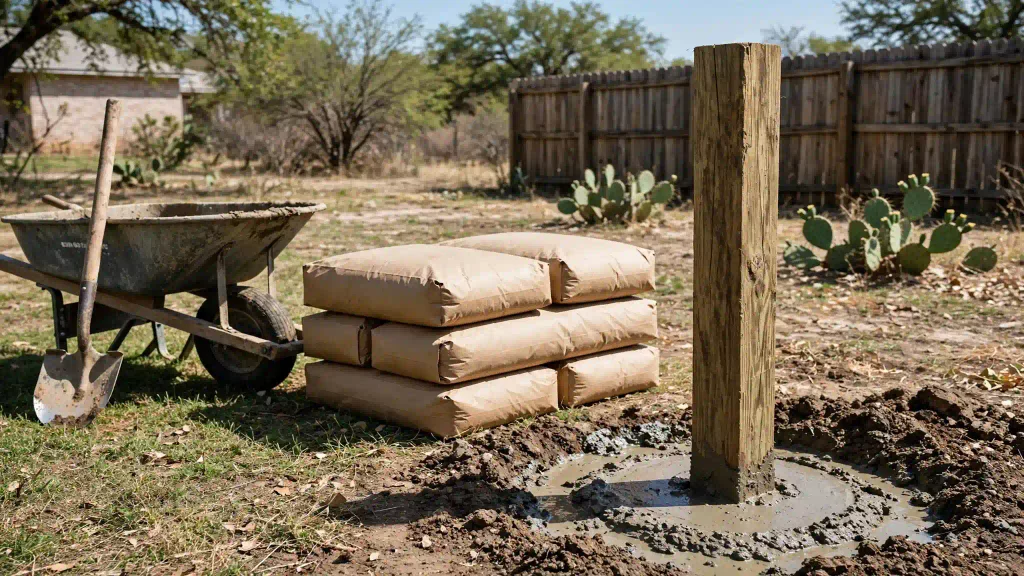
Dig each hole about three times as wide as the post. A 4×4 post measures about 3.5 inches on each side, so it needs a hole roughly 10 to 12 inches wide.
To find the volume, multiply pi by the radius squared by the depth. A 10-inch hole that’s 3 feet deep holds about 1.6 cubic feet. The post takes up about 0.25 cubic feet of that, which leaves about 1.4 cubic feet to fill. An 80-pound bag of Quikrete Concrete Mix yields about 0.60 cubic feet, so each hole takes between 2 and 3 bags.
If you budget 3 bags per post, you’ll likely finish with a few to spare. Once you calculate fence posts, the bag count follows: fourteen posts at 3 bags each comes to 42 bags.
These numbers assume 4×4 wood posts and 80-pound bags. Galvanized steel pipe or C-channel posts, common in North and Central Texas clay, take up less space in the hole, so each one needs a bit more concrete, plus metal-to-wood adapter brackets back in Step 5. Chain link installs usually call for holes about four times the post diameter instead of three (see ASTM F567). Expanding post-setting foam is another option for standard line posts.
| Item | For 100 feet at 8-foot spacing (no gate) |
| Posts | 14 |
| Rails | 39 |
| Pickets | 200 (5.5-inch pickets, half-inch gaps) |
| Concrete | 42 bags (3 per post) |
| Gate hardware | 1 set per gate |
How Texas Conditions Affect Spacing, Depth and Materials

Soil and weather in Texas change how deep you set posts and which materials make sense. Wind can even change your spacing. Keep these points in mind as you calculate fence posts for your yard.
North and Central Texas: Clay soil shifts with the seasons, so plan your deepest holes here. Dig them straight-sided or slightly bell-bottomed, not flared at the top, which gives expanding clay a lip to push up against.
Texas law requires you to contact Texas811 at least two business days before digging 16 inches or deeper, and building a fence is one of the projects the agency names. That covers nearly every post hole. Because 811 only marks public utility lines, locate private lines like sprinkler pipes, pool plumbing and landscape wiring yourself. If a contractor does the digging, the contractor makes the call.
City and HOA rules can also limit fence height and placement, so check them before you order.
6 Common Mistakes When You Calculate Fence Posts
These six errors cause most shortages when people calculate fence posts.
Forgetting the end post. Every open run needs one more post than it has sections.
Measuring from a map instead of the ground. Maps and sketches can be off, and slopes add length plus extra posts wherever the grade changes.
Counting gate posts twice. When you split runs at the opening, the gate posts are already in your total.
Counting rails from posts. Rails follow sections, so use the section count.
Ordering exact numbers for rails and pickets. Buy about 10 percent extra picket and rail material to cover cuts, splits and mistakes. Post counts stay exact.
Skipping the city and HOA check. A height limit can change your whole order.
Frequently Asked Questions
How many posts do I need for a 100-foot fence?
You need 14 posts at 8-foot spacing. Divide 100 by 8 to get 12.5, round up to 13 sections, then add one end post. At 6-foot spacing, the same fence needs 18 posts, and at 10-foot spacing it needs 11. If your fence has corners or gates, calculate fence posts for each run separately.
What post spacing should I use for wood and chain link?
Wood fences use 6 to 8 feet between posts, and 8 feet is the standard for a privacy fence. Chain link is light and open, so it takes 8 to 10 feet. Taller fences and windy sites need closer posts. Vinyl follows the manufacturer’s guide, and iron follows the panel width.
How deep should fence posts go in Texas clay?
Bury about one third of the post, and lean toward the deeper end where clay swells and shrinks. A 6-foot fence with a 9-foot post puts 3 feet underground. Seasonal movement can loosen a shallow post over time. Corner and gate posts carry more load, so set them deeper than line posts.
How many bags of concrete does each post need?
Plan on about 3 bags of 80-pound mix per post for a hole about 10 inches wide and 3 feet deep. A 14-post fence then needs about 42 bags. The math is closer to 2.3 bags per hole once you subtract the post’s own volume, so spare bags are a safe buffer.
Do I count posts the sDo I calculate fence posts the same way for a repair?ame way for a repair?
No. For a repair, count only the posts that have failed or lean. Then check the posts beside them, because a weak footing can spread along the line. FenceRepairTexas inspects the post, footing, soil movement and nearby rails before recommending a reset or a replacement.
in a Nutshell
Calculate fence posts run by run, and add one post at the end of each open run. Then check your total against the tables above before you order.
Prefer a second set of eyes on your fence? FenceRepairTexas offers free on-site estimates for repair and installation, so you know the price before work begins. Request a free estimate at FenceRepairTexas.com or call +1 (972) 525-9448.